by Sean Bellamy | Mar 23, 2023 | Articles
”Sands changed my life. I’ll never forget it. I don’t know where I would be without the confidence that Sands gave me.”
Kate is now off to university and works with both dementia sufferers and supports prisoners through the ‘New Bridge ‘charity.
”Taking challenges and enjoying life. Giving and asking for reasons for everything.”
Marina is training to be a telecommunications engineer at Barcelona University.
Comments like these from ex-pupils remind me that one of the things they most valued about their experience of Sands was the opportunity that they were offered to learn about themselves, their personal strengths and emotional resources. Many say that Sands prepared them, not just for exams and college, but for the real world of work and relationships. They say that the experience of Sands made them emotionally mature as well as intellectually literate.
”I still remember the arguments I had with Nathan, my maths teacher, about philosophy and climbing, feeling that he was seeing me as an equal. I know that experiences like that made me believe that everyone deserves to be listened to.” Kian Clipson, Outdoors Instructor.
Although it is hard to teach emotional literacy, it is possible to create the opportunities and environment in which it develops. Ex and present pupils argue that these conditions exist in Sands. When we have asked them how they think this is achieved, they all say similar things; that the adults are kind and listening people; that they always seem interested in the pupils lives and the school environment is one in which discussions about feelings happen openly and without judgement. But they also say that the easy interaction between all ages is a key factor in the sense of ‘ family ‘ that is at the heart of their
experience.
That means that the school feels safe and that all ages, from child to adult talk to each other. And, maybe more importantly, that the discussion is about so much more than what happens in the classroom. Philosophy, Soap Operas, hobbies, passions and everything in between. Not just exams and performance.
I remember a day a number of years ago, when a group of four students, aged 14-17, decided to avoid class all day and sit on the ‘outside sofa’ [something of an icon in Sands culture]. It was cold and soon they were wrapped in blankets ‘borrowed’ from the Sick Room, but they remained determined to spend the day outside with each other and anyone else who chose to be with them. The teachers could have made a scene about their absence from class, so too the students.
Of course, teachers elsewhere would have disapproved and this probably could not have happened anywhere else but Sands. You see, we all believe that one missed class is not life-threatening, nor one missed day. That is why we all abandon lessons on the first day of real snow, to go and play on the Moor and why the first day of warm sun sees everyone out on the grass. Our sense is, that at best, a day on the sofa talking about life would be memorable and may even create the opportunity for something special to occur. At worst, a day of lessons is missed and another sort of lesson learnt. As adults, we would not be able to measure the learning that took place nor be in control of the outcome and maybe this is why such an event would be disapproved of elsewhere.
As it was, I arrived with hot drinks after lunch. They were still there shivering and engrossed in a conversation about child birth and parenting. It was clear they were having a great day. They asked me to sit with them and fired questions at me about my life as a father and my experience of child birth and babies from my perspective as a man. Questions bounced back and forth between us all. We talked for hours and the depth and maturity of their interest astounded me. Some of those sitting there normally struggled with concentration in class but also tended to be flippant about learning. Not that afternoon. They had learnt huge amounts from each other and were receptive to my experiences as well because it was totally relevant to their interests at that moment.
Had they been present in a PSHE class about childbirth that afternoon, I believe that their relationship with that information would have been totally different. Allowing them to control the moment at which they called for that knowledge meant that they were emotionally engaged and receptive at a much deeper level. They were learning from each other about their attitudes to relationships, marriage, commitment, fear and growing up into parents. They were checking those findings against my experiences. It was a pretty special afternoon.
Educational research talks about the ‘zone of proximal development’ and the ‘zone of reflective capacity’ in which children develop their skills and awareness of morals, emotions and attitudes from competent peers around them as well as from adults. Educationalists found that children were receptive as learners when supported by skilled co-learners who had already mastered skills and tools of communication. Those relatively close in age to the learners were listened to with great generosity. Teenagers, who are notoriously resistant to adult input, had the amazing resource of their more skilled peers to help them evolve. Giving teenagers time to advise each other and scaffold each other’s learning is to take advantage of a wonderful and underrated resource.
Where is the time for this in a normal school day? I don’t know, particularly if we don’t trust children to have unsupervised time out of class. But if we are able to allow children the opportunity to explore their skills, attitudes and feelings in a safe environment both with adults and their more experienced peers, then we are resourcing what we could call ‘three dimensional education’. Academic, emotional and spiritual development can then be offered in schools.
This event was a powerful example of that process in operation. It reminds us that education is not always reliant on adult input and that education takes place all the time and not just in the classroom. And it should be assumed that it is happening all over a school, both with and without adults. In fact, for lots of teenagers they are most open to learning when they are not in the classroom. The artificial environment of classrooms disables many children and it is only when they are released from it that we are able to see their true potential. If that is correct, then the school campus is one huge learning resource. Every child is a teacher and every child a learner.
I see this happening at Sands, when children are sitting together or around a table sharing lunch with adults and each other. Enthralling discussions take place. It feels as if we can be genuine and responsive to each other’s interests.
Then minutes later, we gather for lessons and the opportunity to learn seems to have been enhanced by the equality of what has occurred over lunch or tea. That means that the class room experience is richer for the events that preceded it.
And because we don’t fill every minute of each child’s day with conventional lessons but allow time for play, relaxation and these sorts of discussions, then these informal moments build into a profound alternative curriculum.
The pay back is huge. The school feels happy. Children know that we care about their feelings and their opinions. And vice versa. The result is that they behave as if they co-own the school. It is a place in which they feel they can be themselves. It is a place that embraces their ideas, their moods and their talents. I’m not sure this could be said of many work environments. How many adults feel as if they own their work place and that their emotional needs are valued?
I don’t believe we teach this emotional intelligence, only create the environment in which it can grow. But that requires us to be brave enough to structure our schools so that they give space for the emotional needs of our children to be challenged and developed.
This requires us to give children time in school to talk to each other about their interests and to communicate with adults informally and on their terms. But it also requires us, as adults, to value more than our own specialisms as teachers.
We carry great authority as the owners of the knowledge and skills that children want to access. With the best will in the world, this does create huge inequalities between the possessors of learning, the teachers, and the consumers, the students. If the only time we engage with young people is in this capacity, then why would children ever believe we are genuinely interested in them. They need to know that we see them as more than vehicles to process the knowledge that we impart. If the development of emotional literacy is something we value in our schools, then we need to create the conditions that make young people believe we care about their feelings and their opinions, not just how well they perform.
Often, one feels that teachers believe that children are actually interfering with this performance, getting in the way of the teaching and that the subject is much more important than the students. Certainly, I often feel that in many schools, the grades are more important than the child. And the students definitely feel the same.
If we want our children to really connect to holistic, three dimensional learning, then we need to connect to their characters. That means embracing their personalities and enjoying the times they disagree with us.I want them to challenge me. That is often when they are most intellectually and academically alive. And often those children, who manifest that challenging behaviour elsewhere, are labelled as difficult. They are often the mavericks who are most in touch with their characters and have much to offer us all. I wonder why they so often find themselves at Sands?
I am arguing that teachers need to get out of their classrooms. To be prepared to be ordinary people who are not in charge of learning; let go of the power they have and value the fact they have genuine life experiences to share that could be part of the broader education of our children. We need to value our skills as parents and citizens of the world as well as those we possess as teachers. Be prepared to sit with children and join them in discussions about themselves and not exams. Be wrong, be interested and be prepared to learn from a child. When I’ve shown real interest in their lives and attitudes, then that
reflects back into the classroom beneficially, with the children repaying my respect with their patience and interest.
That is what many of our most successful students valued most about their time at Sands. Learning everywhere, learning about everything and arguing about everything, ”taking challenges and enjoying life. Giving and asking for reasons for everything”. And so they left us competent and confident.
We can’t measure this ’emotional quotient’, but we all know that to be emotionally literate is to have an invaluable life skill. We can achieve a string of top grades, but having the wisdom to know how to use those qualifications and communicate one’s passion for learning to others, requires more than the ability to regurgitate facts and do exams well. To develop rewarding relationships and express one’s needs sensitively cannot easily be taught in PSHE, though there do exist remarkable teachers who seem to be able to do that very thing. But when you ask students how they achieve this, it is invariably because the students recognise in that teacher those very qualities to which I have been referring.
Emotional intelligence could be modelled throughout schools as a living, genuine form of everyday communication that happens between all ages. It could form part of an alternative and complementary curriculum. But it needs space and time. It seems a huge ask for larger institutions, but in the democratic schools worldwide that I have visited, and many are large, with pupil roles over 300, emotional literacy is as valued as every other aspect of a child’s education. Students and staff in those schools talk about how happy their schools feel and as a result how much people want to learn. Maybe, if nothing else, we should realise that emotionally literate children make better learners. Schools that embrace E.Q are happier and safer places. Maybe that is enough for most of us to invest effort in exploring how we can encourage children’s voices and emotional interests to be met.
by Sean Bellamy | Feb 22, 2023 | Articles
When was the last time you played? Did it involve giggling spontaneously, hiding in cupboards and running in places designed for walking? And when was the last time your child came home from school and told you about a game they had played rather than something they had learnt? I ask the same question even if your child is a teenager.
One of the students at Sands, who has subsequently become a teacher herself, told me that adults didn’t stop playing as they got old, rather they got old when they stopped playing. She was still playing ‘hide and seek’ on Dartmoor with us when she was seventeen and made sure that the staff always joined in. I can remember the excitement I would feel when crawling through the undergrowth to get back to base. I was probably 40 years old then. I’m 52 now and still take children to the ‘Moor’ because we all want to play games. The first snow fall signals a mass exodus for snow ball fights and when the river is barely warm enough the afternoons are spent leaping into the Dart.
Our day runs from 9.15 in the morning to 4.30 in the afternoon. We do not begin classes until 9.45, allowing children time to get a late breakfast or catch up with tutors, but we find that lots of the children grab their friends and run into the garden to play games. Most break-times someone will be heard trying to drum up support for a game of 20:20 or ‘flags’.
In the summer term, we all eat lunch out on the patio and lawn. On one occasion, we were visited by a teacher from the local State School. She was looking down the lawn and drew my attention to an older girl creeping up on a younger child. Her initial reaction was concern. Student A then leapt out and onto Student B in a fit of giggles. Student A was sixteen years old. Student B only twelve. Student B was now very clearly ‘on’ and had to take her turn catching the rest of the players. When pudding was served most of the players abandoned ship. Apple crumble can undermine the best game and the best lesson.
”Play is the most democratic of activities for it is the only one in which you are free to quit.”
I have to admit, I too was relieved because Student A was one of our most difficult students. She had faced a number of School Meetings and had been regularly sanctioned for her wild behaviour throughout her school career. She had never been given lines as Mr Gove would have recommended and the only cleaning she ever did was as part of the cleaning we all do at the end of the school day. We do not employ cleaners believing that we should all take responsibility for the mess we make. And we would hope cleaning was seen as part of everyday life and not a punishment for poor behaviour.
But on that day she was running around the school garden like a kid again. Uninhibited and care free.
In another incident, we accepted a young man who had been written off by the education system, relegated to a special school where children were regularly violent and restrained. Student X was very, very bright, chaotic and affectionate and never violent although he kept a journal that was filled with deeply visceral and angry images. His mother decided to take a risk and pull him out of the education unit and place him with us.
We fell in love with him. He came and spent the first three weeks playing. Not ‘hide and seek’, not ‘murder in the dark’. But in a sand pit that our caretaker’s wife had built for her daughter. Make of that what you will, but he left Sands an emotionally literate and talented young man who is now much sought after for his film making skills. Play was his antidote to the system.
At Sands, we don’t have a philosophy or policy about play. We just don’t interfere and when you stop interfering play happens. If you give people the space and time. If they feel relaxed, then the next thing that often happens looks very much like play.
You would be wrong if you thought that children at Sands do not take their studies seriously despite this informal atmosphere. Last year, we spent dozens of hours in meetings with students asking them their priorities for learning. They told us that they would like us to spend more of our budget on Teaching Assistants with specialisms in particular academic subjects and in sport to support both those with learning needs and the gifted. We also introduced, what the children have termed, ‘master classes’ in which we offer advanced study in mathematics, sciences, music and art. Open to all ages and abilities, they are designed to challenge even the most gifted and extend our curriculum in creative ways that are much more than ‘chalk and talk’.
Perhaps I should qualify my statement about play. As a teacher and parent, I have been taught by children that play can take many forms. Using play dough, train sets and Frisbees, but it can also happen in the classroom when discussion goes free range and creative, when the clay under one’s fingers comes to life and when the pen produces beautiful phrases. Creativity is a form of exceptional play and we are liberated into that state of mind in environments that are respectful of us. External pressure, endless demands to perform and stressful environments rarely engender creativity. They certainly do not lead to happy children.
I write this in response to the news that our Education Secretary has announced his intention to increase the length of the school day to ten hours ostensibly to emulate the performance of schools in Asia. Paradoxically, just months before Gove’s initiative to bring us in line with schools in Singapore, Japan and China, the Chinese government had issued a report-entitled, ”Ten Regulations to Lessen Academic Burden on Children in Primary Schools” -calling for shorter days, less homework and reliance on test scores as a means of evaluation. The actual details are available at Yong Zhao Blog. ”China enters ”testing free” zone. The New Ten Commandments of Education Reform.” e.g. there will be no written homework for primary age children, strictly no extra classes after school hours and no fast tracking of children.
Educators in Asian schools have begun to express anxieties that excessive demands put upon children in the school system are effecting their health. Suicide rates are frighteningly high amongst secondary age children and from the outside it appears that childhood has been abolished. Parents at home emulate the pressures put upon their children at school. ‘Tiger Parenting ‘ is a term describing this approach. But one father, himself a highly successful businessman, who had been through this intense education system himself recognised how little it had prepared him for life, ”Then you go into the world and not only are you socially inept but you find yourself attracted to people who replicate those same dysfunctional dynamics.” When asked what the last game he had played with his daughter was, he realised that he could not remember ever playing a game with her. He is now campaigning to free his own daughter from the rigours of similar schooling. Ten hour days, Saturday morning study clubs, extra homework and constant pressure to perform on both children and teachers. Sound familiar?
”Because children spend nearly all their time studying they have little time to be creative, discover or pursue their own passions or develop physical or social skills. As a result Chinese school children suffer from extraordinarily levels of anxiety, depression and psychosomatic stress, which appears to be linked to academic pressure and lack of play.”
[Peter Gray, The Independent]
The message from these studies is clear. Life for children has been ”schoolified” to such an extent that it has become the predominant activity in their day. In a world in which they are encouraged to grow up too fast we need to protect those precious times when they have the opportunity to be relaxed and creative. We can probably all remember day dreaming in class. I watch children do it all the time. I’m either a really boring teacher or it is a natural state we all enter into at times. Irritating isn’t it, but now that mobile phones, media, Facebook and TV fill all our children’s spare time, I wonder when they do find time to day dream? To be lost in their own thoughts and not reliant on input from the outside?
We have been visited twice in the last three years by journalists from South Korea; a film crew and representatives from Seoul’s major newspaper. Both had heard of Sands through our international partner schools and wanted to find out if there were things they could learn from us that could be incorporated into South Korean schools that would improve the quality of children’s lives trapped in a never ending cycle of work and pressure. The female reporter from ‘The Kukmin Daily’ cried when she was shown around the school by students.
”This is what childhood should be like,” she said. In South Korea, parents who are brave enough to challenge the orthodox view that education is all important are shunned by their communities. She had wanted to be an artist, but had to endure ten hour days studying subjects that meant nothing to her; she had endless homework and Saturday ‘study clubs’ with her form tutor who was obliged to give up his free time to prove his commitment to his student’s academic success. She left Korea at eighteen and became a journalist and part-time artist in this country. Had she stayed she believes she would have
been broken by the system. Her parents still refuse to talk to her.
These journalists have returned to South Korea hoping that they can say something that will encourage schools to return to the students some of qualities of childhood and the freedoms essential for healthy growth.
Most worrying for our children is that this research proposes, if denied the space to daydream, play and be creative and instead are constantly directed and put under increasing pressure to perform, then their mental health is at risk. Narcissism, depression, lack of empathy and anxiety related disorders are on the increase. Five to eight times more prevalent than in the 1950’s. As with Student X, maybe play is the antidote?
But, I wonder if school destroys our interest in play? Is it that we are told so often to stop playing and get on with our work that we fail to realise that the best play is often the best work. Maybe the reason we stop playing at about the same time we leave school is not because this is the natural time to stop but rather that it has taken this long to finally drive any sense of play out of us. ”I’m never doing Shakespeare again..You will not catch me running again..I can’t do number games..etc ”. I have met lots of adults who cannot play any form of competitive game, be it cards or ‘Monopoly’ because they cannot escape the feeling that they may fail or humiliate themselves. It is often their school experiences that have created those deep insecurities. When our learning feels more like play then I wonder if failure is not only easier to accept but only encourages us to start again?
All people are creative and revel in this thing we call play. We see it in our younger children all the time. We seem to trust that for them play leads inexorably to competence. It is an amazing resource. And yet as they grow a little older, we lose our faith that play is implicit in growth and maturation. The two seem polar opposites and yet some of our greatest innovators and thinkers used play to develop their theories and inventions.
”In their play and self-directed exploration they create their own mental models of the world around them. Adults whom we call geniuses are those who somehow retain and build upon those child like qualities.” argues Peter Gray in ”The Independent ” [www.independent.give childhood back.]
Albert Einstein said that his schooling almost destroyed his interest in mathematics and physics. He referred to his innovative work as ‘combinatorial play’. Committing thousands of hours to study, he still achieved the speed of light in his imagination chasing sunbeams. He daydreamed his way to new theories.
I think we would be wise to give children more chance for their own daydreaming and make-believe in school. I am also advocating ‘play’ in its broadest sense. My daughter told her Drama teacher that she felt that all they had been doing in the course was having fun. She has still spent hours learning lines, designing props, costumes and inventing characters, improvising and being creative, coming back late from the theatre and yet she believes she has been having fun. I am not arguing that children should only be climbing trees, only that we should not orientate all their day towards testing, directed activity and the acquisition of knowledge.
These ten hours days that Gove is proposing are to be filled with only directed activities. Children will get home at 6 o’clock or later. It will be dark for much of the time. When asked to comment on the research that suggests he is fundamentally wrong, that his initiatives will harm children and work teachers to breaking point, he replied that, even if he were the Angel Gabriel someone would still criticise him for being too shiny. I’m glad that he hasn’t himself lost the ability to fantasise and daydream but I can’t imagine he remembers how to play, if he was ever allowed to. And as such why would he be able to see the value of undirected activities, shorter days and leisure time for children in school. I’m sure he just wants them to grow up as quickly as possible into working adults.
But adults don’t really want to grow up, to escape the world of fantasy and make believe. If we did would we still go to the cinema and read books about other worlds and the impossible? Would we still play Charades and make sand castles on the beach? How many of us know someone who is ageless because they are still having fun and have enthusiasm for life? Don’t we watch young children, lost in their imaginary worlds and feel a little jealous that we can’t go with them? As Immalee said, ‘We grow old because we forget how to play.’ It would be really sad if we looked at our own children and realised they too had forgotten.
by Sean Bellamy | Feb 19, 2023 | Articles
”When people are good only because they fear punishment, and hope for reward, then we are a sorry lot indeed.” – Albert Einstein.
There was a rule at Sands School until recently that fridges could not be dropped out of trees. There was never any corresponding punishment created. This rule has recently been removed because there are no longer any fridges in the grounds awaiting this sort of experimentation.
In fact, ‘fridge dropping’ happened only once, but the event soon became part of our mythology. No one wanted to remove it from the list of written rules. It seemed so ludicrous that its presence seemed to say something profound about the school’s attitude to behaviour and punishment. There are very few written rules and these are regularly reviewed in order that the truly irrelevant ones rules can be abandoned.
So there are no detentions and nobody has ever been set lines or any academic work as a punishment for poor behaviour. Just as we would hope that mopping a floor is not automatically viewed as a punishment, so we would hope that writing a hundred lines of anything is seen as positive thing to do.
The use of or possession of any controlled substance is not allowed and breaking of these rules leads to automatic suspension. Expulsion is an option if the school feels that a student cannot be trusted to uphold this core principle and care for themselves or others. But we always hope that we can learn through a process of reflection and once this has happened any other consequence looks more like revenge.
There is no uniform code as there is no uniform, although there is an unspoken expectation that what we wear does not offend others. No one may wear shoes upstairs. This protects the carpets from mud. The big loop-hole is that there is no corresponding rule to stop the ‘wearing of bare feet’ and as bare feet carry just as much mud as boots then the carpets do get dirty.
And although it is common sense to preserve our carpets as long as possible, it did take months for everyone to change their previous habits,and we have saved thousands of pounds which we have spent on more creative things. So dry, bare feet are allowed and we remain ever hopeful that our students and some of our staff develop the skill to remove feet as well as shoes in wet weather. And we love the fact that we can all go barefooted at any time of the year and maybe dirty carpets are a fair price to pay for this freedom. Common sense is a strange thing isn’t it? It is a fragile thing particularly in our post truth world or rather it speaks its truth ever more quietly and is hard to hear in the cacophony of opinion that floods the airwaves.
And just as in a family, the rules that are sensible tend to have a much longer life than the ones that are not.
A very long time ago, within the first few years of the school starting, we all agreed upon a rule that no one, staff or students, should go to the local shop for chocolate, crisps or drinks until break-time or lunch. The shop was just over the road. The logic was that because staff and students were ‘nipping’ across the road for a snack between classes, many of us were arriving late for class. It was really irritating for everyone who arrived on time.
The majority voted for a new rule.
Half the school, staff and students, went to the shop as soon as the ‘Meeting’ ended. People argued that it would take less than one minute to visit the shop, and although this was blatantly not true, what was true was that getting a snack would interfere less with the smooth running of class than being hungry and thirsty.
The rule had lasted for approximately thirty minutes. We officially abandoned it the following week. But we now have a rule that anyone arriving more than 10 minutes late to a class can be excluded, if the class feels it appropriate. I was excluded from my own History class while strolling in late with a cup of tea and an excuse about an important phone call. Message received!
If you eat school lunch, then you wash up once a week. You are in a team of staff and students. And everyone is expected to tidy at the end of the day. Having no cleaners ensures that we all appreciate the value of tidying and taking responsibility for our own mess. Even teenagers, whose bedrooms, according to parents, resemble war zones, are often amazing at ‘Useful Work’.
Students are elected to co-ordinate this tidying process and they are the ones who remind, cajole and hand out punishments for the pathologically lazy. We all agree that those who fail to tidy are essentially expecting that others do their job for them. When ‘ found out ‘ they are then required, in turn, to do the number of hours owed in washing up. Failing that, the work phobic get to explain to the Meeting why their friends and colleagues should carry the school for them.
You are meant to walk with your skateboard into town and running on the garden walls, no matter how exciting, is prohibited. The walls are old and in constant need of repair but there are very tall trees to climb, fires to light and sit around, skate ramps and a very vertical climbing wall in an old chapel. We are not averse to risk.
All these rules have been arrived at through consultation and a process of voting with the staff and children in School Meetings over many years. Contentious issues lead to secret ballots or we search for consensus. But we always aim to keep the number of written rules and guidelines to a minimum. The lack of them either says something about how chaotic or just how well behaved the students are.
A friend of mine from Glasgow, said that in one particularly violent night club he used to frequent, there was a poster on the door announcing the prohibition of drugs, knives and prostitution.
The night club was famous for its knife crime, street drugs and prostitutes. Rules didn’t prevent crime and violence. They just identified which ones to expect if you made it through the doors.
Similarly, school rules seem to reveal the pathologies that each school faces. ‘You may not run in the corridors, wear your tie a certain way, you may not do this and this behaviour is banned’.
The rules rarely create a change in behaviour. Rules, punishment and rewards define the boundaries of any given culture. And the rules at Sands, just as in the Glasgow night club, describe the everyday behaviours that the majority feel need to be challenged.
So, at Sands, based on this principle, expect to see children and adults walking around with bare feet, making mess throughout the day, running on walls, skating where they shouldn’t, arriving late for things, forgetting to wash up and rarely, experimenting with drugs and alcohol.
When a friend read this last paragraph, they told me that it sounded as if I was describing the average family with teenagers. Not a school. If that is the case, then I think maybe we should be really proud.
The rules we do have address the everyday cultural problems that this informal, human scale atmosphere creates.
At the heart of that informality is the belief that children are essentially wise and that if they are given the space and trust, they will use school wisely and behave well most of the time.
The behaviour that is consistently good needs no rule, but it benefits from us acknowledging it and isn’t it fascinating how invisible the well behaved can become?
Similarly, if this system applies, fridges are no longer dropped out of trees, students wear appropriate clothing, are kind to each other, behave well in class and are keen to learn, do not consistently vandalise the school and are generally polite to staff and each other. Certainly, the absence of rules about these things may well be relevant.
Yet there are sufficiently few rules at Sands to allow everyone space to create their own code of conduct. That does not mean that we experience perfect behaviour, but students do feel that they are able to make personal decisions about their school life and are able to take responsibility for that behaviour and any sanctions they face as a result. The lack of petty rules means that we are not in permanent low level conflict with students. The opposite is true of most other schools I have visited. The majority of Sands students uphold the rules because they know that they have discussed them and designed them.
The rules comfortably fit onto one sheet of A4 paper. There is a similar democratic school in America and their rule book runs to 25 pages!
In this environment, it is easier to discuss with the children why they break the few rules that we do have. The Student Council [ an elected body of six students and sometimes a teacher] initially handles all these infringements, often with greater skill than the adults. Tutors are drawn in to act as advocates for their tutees if necessary and discussion continues in the hope that behaviour changes.
Often, when a child gains some insight into their own poor behaviour and its impact on others, then they don’t transgress again. Though we do have punishments, we have found that they are often less effective tools to encourage reflection than conversation. And reflection is at the root of better behaviour. Punishment looks more like revenge if it is meeted out after the student has already acknowledged that their behaviour needs to change.
”When a child can be brought to tears, and not from fear of punishment, but from realisation and repentance the child needs no chastisement” Horace Mann.
What is apparent is that most of us choose to behave well because it is the right thing to do and not just because of the rules or fear of punishment.
Clearly, we are very lucky to be able to work in a small school with only seventy five teenagers. Human scale communities have the luxury to find the human scale solutions that are denied some bigger institutions. However, we do attract the mavericks, the rebellious and often those who have failed or been failed by bigger schools. Some come disillusioned with adults and
education. The freedom we offer to re-engage with learning on their own terms is the same freedom that allows them to misbehave and make mistakes.
And even poor behaviour can be seen as resource. When the students witness the transgressors treated with understanding and respect, then they too may model that in their own lives. Of course, everything including mopping floors, suspension and just apologising should be available as consequences for bad behaviour. It does not mean that the school needs to be complacent about the outcome or punishments, only that they should be arrived at in a way which demonstrates intelligence and compassion. That may well be easier in a small school.
Recently when visiting a local school considered the ‘Microsoft’ of Comprehensives, I was told that they have an inflexible uniform code and similarly immovable code of punishments because strictness about these things prevented more serious transgressions. What the teacher actually said was that the ‘top button’ rule was there so that students had something less significant to rebel against; that obsession with top buttons meant that staff were more likely to have to deal with this than taking knives off children. Children will rebel against something, he said, so giving them a uniform code to rebel against somehow vaccinated them against the more serious crimes.
“I doubt whether classical education ever has been or can be carried out successfully without corporal punishment.” – George Orwell
I am sure that large schools face challenging behaviours on a scale incomprehensible to us in the tiny world of Sands. We see fewer children in a week than colleagues in larger schools see in a day. I have nothing but admiration for their skills and resilience, but the reason we created this small school was so that we could remain at a human scale and investigate the potential that exists when children are given space, time and trust to find their own way through this thing we call education.
That means we have the luxury to see what happens when children help design their own rules and the subsequent punishments. What we have discovered is that petty rules create unnecessary conflict and a truly cooperative and compassionate approach to’ behaviour management’, that relies on discussion rather than penalties, may be at the heart of a happy school.
But, rarely, the most compassionate thing to do is to expel a child. In our culture, we trust children to make good decisions about their school lives; in how they treat each other and how they respect themselves and the school. Just occasionally, a child joins us, who has few internal boundaries and misunderstands our faith in their ability to self- regulate as weakness, and as a result use the school chaotically to their detriment and others. They break the rules and ignore the guidelines to such an extent that Sands becomes a negative experience for them. And all of us.
In most cases this rejection of the rules is a temporary thing that changes as a student gains insight and develops their self- respect, but if not, they need to know that patience is not an infinite resource. Though we are infinitely patient.
So, perhaps the measure of a school is not just how few rules it needs, but how those rules are arrived at and how they are subsequently upheld. I am guessing that most students in conventional schools don’t stop each other in the corridor to complain about skirt length and top button infringements, but at Sands students often uphold the rules and tell people to take their shoes off upstairs and drag their friends and staff to Useful Work.
“Power based on love is a thousand times more effective and permanent than the one derived from fear of punishment.” – Mahatma Gandhi
by Sean Bellamy | Dec 23, 2022 | Articles
Some ideas about the relative merits of uniforms and the value of allowing children the opportunity for self-expression through clothing.
“We leave such a trail of bodies through our teens that it is hard to tell which one is us. How many versions do we abandon over the years?” (Among the Missing by Dan Chaon)
It would take my younger daughter hours to choose what to wear for playgroup – or rather hours to decide what not to wear.
She used to scream with frustration or just stare at the pile of clothes and cry. Eventually my wife would sit with her the night before, sifting through her trousers and tops and they would lay out only two sets of clothes. In the morning Megan was allowed to choose one or the other. It still took her an age but at least we got to kindergarten on time without her having her regular meltdown.
We were never sure whether she struggled because she was worried about how she might look or whether she was incapable of making choices. She was able to decide about all other aspects of her life but it seemed as though having to make choices about clothes paralysed her. Neither of us wanted to protect her entirely from the need to make decisions. We were conscious of the value of bringing up our children to take responsibility for their own lives, and we supposed that deciding what to wear each day was part of that process. So we found ways to support her in her daily trawl through her relatively small wardrobe.
My elder daughter never had difficulty in deciding what to wear. It was simple. She just took what ever was nearest her when she fell out of bed, or what ever was comfiest, warmest and most practical. Though that has changed since she has become a teenager, she still approaches clothes very differently to her sister, but they both have their own unique styles and value being able to wear what they want, be that a lion suit ‘onesy’, Doc Martin’s, 70’s sheep skin coats or jeans and sweat tops. There are days when we still arrive late for school because the eye-liner won’t go on or because of some other fashion disaster but as they have never been to a school where there is a uniform, deciding what to wear each day has been part of their childhood experience.
They have many friends who attend schools which do have uniforms. It seems that these friends all face similar dilemmas about fashion but they have to work within the confines of the subtle variations that can be applied to ties, shirts and skirt length without falling foul of the staff. But invariably they still try to express their identities within these limitations.
In a world where there are children who can’t even afford clothes, it seems indulgent to worry about the importance of
allowing teenagers to choose what they wear, but I am still left with a sense that the debate about the value of uniform is
worthwhile. There is something about the potential for selfexpression through dress, the sense of identity that comes with it,
the artistry of treating clothing as more than protection against the elements that seems a great resource for an age-group who value autonomy and freedom.
Both my children are now at Sands School where every day they are confronted by seventy-five teenagers wearing whatever
they want. We have Goths,70’s retro, sloppy, tweed, the odd punk; someone may even wear an old school uniform; anything is possible. Some new arrivals immediately experiment with dress in wild and exaggerated ways as if seeking some sort of catharsis. Others spend their days in pyjamas or dungarees. There is no consistency, but Sands is a happy and colourful place.
I have taught at Sands since it was opened in 1987. Children and adults designed the school together and from the very first
conversations it was clear that having the right to choose what to wear was important to us all. The people who were most vigorously opposed to uniform were staff and children who had come from schools which had elaborate and strict dress codes. Such codes were condemned as petty, divisive and the cause of irrelevant conflict. At Sands we all wear what we want.
Megan still considers what she wants to wear the night before. It is no longer a struggle, in fact, she loves designing her look and has become fascinated by fashion, making her own clothes, researching styles and genres on the internet and even going to London to scavenge retro-fashion at Camden Market. She has an old Singer sewing machine which she manages to break every few weeks. She loves the fact that she can take her passion to school every day. One of our ex pupils has gone on to work in film as a costume designer and ‘dresser’ on films like Sherlock Holmes and Les Miserables. Her work featured in our Art exhibition celebrating twenty five years of Sand’s art.[www.sands-school.co.uk]. And as a result, this generation of pupils have been inspired to attempt similar things. Teenagers are just fascinated by what clothing can say about the human condition.
A few of the children who come to Sands do so because they have refused to conform to uniform codes in their previous schools. When I speak to adults about their experience of their school life and uniform, the majority recount that they constantly broke the dess-code in order to conform with the latest sock or tie fashion. Irrespective of the schools attitude to skirt length or shoe colour, as teenagers, they needed to reject adult authority and at the same time express their allegiance to each other. The desire to be individual and yet conform defines the contradiction and the challenge of being an adolescent.
‘The young always have the same problems – how to rebel and conform at the same time. They have now solved this by defying their parents [and teachers] and copying each other.’ [Quentin Crisp,1954.]
For these teenagers who join us because they have fought against their schools uniform code , rebellion has become their default setting. They have been labelled as difficult and uncooperative. They tell us time and again that the uniform rules were petty and their respect for the adults who upheld those rules was diminished. This meant that it became harder for them to respect those adults as teachers. Poor behaviour in the classroom was often connected, they say, to the conflict over uniform, jewellery and make-up that seemed to absorb much of teacher’s time outside the classroom. Raging against the system, against adults, wasted much of their time as students as well. So the very thing intended to encourage better behaviour, allegiance to the schools identity and then better results, had exactly the opposite effect on these particular children.
Not every child who comes to Sands has this attitude to uniform, but they all say that being able to wear what they like
each day makes them feel more relaxed. And certainly, the absence of uniform has no effect on behaviour or concentration in class. We never really expected it to, as we have all witnessed our own children out of school behaving well. They are able to commit to study at home wearing, jeans, t-shirts or pyjamas. I have never found that a uniform helped my studies either. I did some of my best work at University wearing an ancient sweat shirt. There have been attempts to study the correlation between uniform and improved performance and behaviour. ‘Mumsnet’, a significant force in’ parent voice’ is involved in some practical debate about it, but the research seems to be inconclusive and my best guess is that the proponents for uniform are able to quote evidence to support their views and vice versa. However, the ‘Sutton Trust’ have produced a fascinating document in which they argue that presence of uniform has a lower impact on school performance and behaviour than once thought and that money would be better spent on things like reducing class size, peer mentoring and giving teachers the time to give quality feedback about children’s work.[www.sutton trust.com] Similar research in the States has come to similar conclusions. [Joshua Reed has undertaken an M.A into this in his thesis, ‘Effect of a school uniform policy on an urban district school’…and concludes that uniform has no impact on behaviour in Junior and Middle schools and is perceived by students to have no impact in High School]
So, schools full of people wearing what they want could be both vibrant and relaxed and successful. A lack of uniform need not affect the quality of education or how well children behave. It could make people feel that there is equality between staff and pupils. That may breed a mutual respect that is felt throughout a school. Something as visible as a ” no uniform policy ” could be a potent symbol of democracy in action and remove one of the ‘flash points’ when relating to teenagers.
Conversely, latest trends in uniform have become a potent symbol of something else: corporate identity and branding.
Recently, when we were asked to attend a seminar for training teachers, the deputy head of a large and very successful
comprehensive announced to the young trainees that the single most important aim for the school was to create ”a clear corporate image.” He stated that the uniform was an inherent part of this objective.
”Heads and Deputies are increasingly looking at well designed uniform and sportswear as vital tools in the development of a
distinct brand identity…
”We chose a clear evolution of the existing uniform, moving the jacket into a more modern feminine style with a subtle red piping. We added a real wow factor with the red lining giving a genuine sense of identity and distinction.” [ ‘Uniform equals Branding”. The Independent Schools Magazine. 2014.]
Very few European schools have uniforms and in Scandinavia, where their results and academic achievements far outstrip even our best schools, the idea of a uniform would be an anathema.
Of course, in a world where self image is controlled by the media and fashion industry, we may be doing our children a favour by releasing them from having to choose what to wear. For a few hours each day the uniform frees our children from the clutches of the fashion magazines and the TV, even if they are still in the clutches of the school image consultants. And it saves us the terror of watching our teenagers fretting about fashion, spending hours in front of the mirror, grooming and worrying about their figures. Maybe we protect them from potential bullies and we may be able to reduce the obvious inequalities that arise when fashion favours the rich. We live in a world in which so many children don’t fit in.
We can all sympathise with the torment of not knowing what to wear, how to be and who to be with. The fear of getting it wrong and being ostracised and humiliated. Maybe removing the problem of choosing how to present oneself is an obligation we have in the present climate of anorexia and cyber bullying?
”She is a loner, too bright for the slutty girls, too savage for the bright, haunting the edges and corners of the school like a sullen disillusioned ghost” [The Rehearsal by Eleanor Cotta.]
At least a uniform homogenises, removes the very anxieties that my youngest used to suffer and creates an equality around clothing. It maybe that the uniform itself encourages children to rely on qualities other than image to reveal their true personalities. Maybe fashion becomes a crutch and allowing them to choose what to wear panders to the insecurities of our children and they are liberated by the uniform?
”For in todays generation of teenagerdom finding acceptance is hard, especially for those who dare to be different.”
Homogenising need not be a terrible thing if the intention behind it is good, but reducing our children to mannequins
projecting the school’s ‘corporate image’ denies them a wonderful opportunity for self expression in order to satisfy an increasing obsession with turning schools into businesses at the expense of the staff and children within them.
Maybe this is part of the reason I am so interested in schools allowing children and staff to wear what they want. Our students
tell us that they believe it is a basic right for people to be able to express themselves through their dress. I believe that this is particularly true of young people and teenagers. Experimenting with one’s identity is a fundamental part of growing up. For me, Sands, is a place that recognises that need, valuing the right for self expression above any need to project corporate image or group identity.
‘A thirteen year old is a kaleidoscope of different personalities, the colours reflected in what they choose to wear.’ J. Mitford.
‘As a teenager, I didn’t want to be me. I wanted to be many different people. Maybe I realised that they all live in me and that
if I managed to connect with them ,they would become aspects of me.’ [ Marion Cotillard, actress and civil rights activist.]
by Sean Bellamy | May 14, 2020 | Articles
The culture of care and compassion at Sands often seems to extend to issues that are outside of the school community.
This year I bought a copy of Greta Thunberg’s book ‘No One Is Too Small to Make a Difference’ into the school. When I presented it to a group of students in the office, in the hopes that I could pass it onto someone who would enjoy it as much as I had, I was politely turned down by the group, who all excitedly exclaimed that they had read it already.
Once a week the student body meets to have a meeting which exclusively discusses the environment. What I noted, while attending these meetings as a supply teacher and ex-student, was that even the youngest child in the meeting seemed to understand the importance of this issue. Discussion often revolved around four questions.
How could the school make a difference to the decisions of policy makers?
What could the school do to reduce their impact on the environment?
How should the school represent its values to the wider community?
What news was there of research or otherwise that needed to be shared?
The students always seemed keen to follow up these meetings and this made the following actions possible.
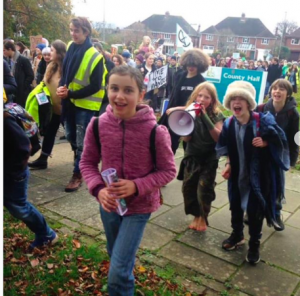
Children from every year groups went on all the Friday marches to protest the lack of adequate government response to climate breakdown.
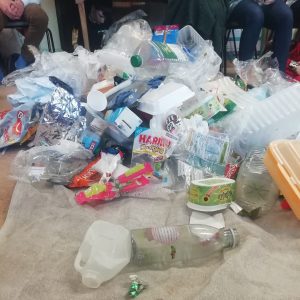
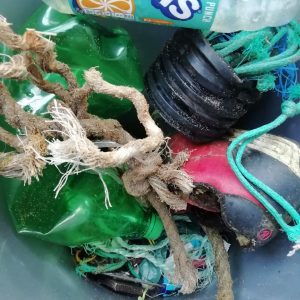
Students and staff collected all of the plastic used by the school in a week and dumped it in the middle of the school meeting to demonstrate how much waste the school created (leading to a long discussion and several other initiatives).
A Waste Free Wednesday was started, where all the bins were removed for a day and all the students had to take their rubbish home with them.
Trees were planted in the grounds.
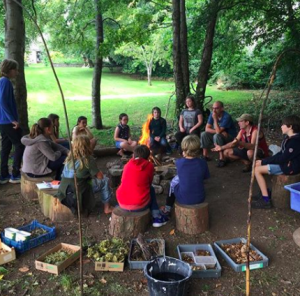
Students gave trees for Secret Santa gifts.
Students went to the coast and spent the afternoon collecting plastic and playing on the beach.
Lots of discussions were had about where our food comes from and the benefits of buying local.
Many discussions were had about the pros and cons of having vegan school lunches.
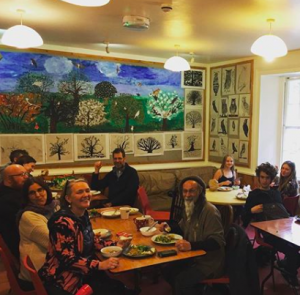
The school started making oat milk for tea and coffee.
There was a visit and talk from Precious Plastics, an international plastic recycling project.
There was a presentation of a rewilding project at Knepp Farm and this resulted in a plan for a Y group residential trip (now to happen after lockdown).
The school did an art project painting our native birds.
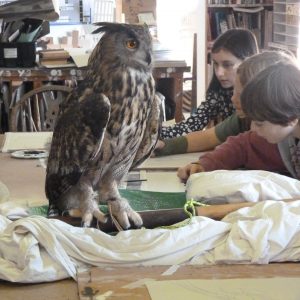
Children took part in the RSPB Big School’s Birdwatch.
A student put up bird feeders and took on the job of re-filling them regularly.
The school’s gas supplier was switched to a green one.
There were discussions about reducing energy use in the building – switching off lights when leaving rooms etc.
Finally, a decision was reached not to fly for school trips.

All of these are an example of the type of education that is possible at Sands, because the school has induced an environment in which children can have meaningful discourse and drive action on real world issues.
